Thursday, September 12, 2013

Chakra: Chronicles of the Witch Way

Review of Chakra: The Chronicles of the Witch Way.


Indian market has yet to witness the popularity of novels dealing in super natural elements. The Indian readers are still not adapting to such readings. Although over the years, fantasy novels do charm them but not many of them are glued to them till the end. I experienced the same dilemma before picking up the third novel of the well-known author and blogger, Ritu Lalit, Chakra: Chronicles of the Witch Way. I had my doubts regarding the content of this book.

The first impressions of Chakra were a nice gripping cover design that enticed me to go on further, the great paper quality that made me feel utterly happy, and the magical world awaiting me in the realm of those papers. As I went on further, each word used by Ritu Lalit to describe the Japas, appealed to me and shook my imagination. Vivid pictures started getting created as I turned the pages. It was so gripping that I could not keep it down as Nandita Bose has rightly quoted, ‘An unputdownable supernatural saga of power plays and mystical allure that grips and entertains like dynamite.’ She had said in various interviews that her stories are a hugely inspired by the tales of rishis and munis her grandmother used to tell and it is very much evident from the book.

Ritu Lalit actually gave me a vision through this book; a vision to personify the five elements and explore their world. A magical tale in all its aspects, it gripped me from the beginning. I started believing in the existence of Japas and Japnis and lived this tale. The characters are so perfectly described that I could see them emerging out of the book right in front of me, playing their designated parts. It was flawless. Ritu Lalit did a marvellous work in this genre. I can say without any second thoughts that she researched a lot for this book. Such a masterpiece wouldn’t be possible otherwise!

Chakra is a beautiful journey imbibed with elements of suspense and thrill, magic and surreal effects laced within its folds. It’s not a simple fantasy story that can be read by kids and enjoyed, it requires your full attention and involvement; somehow Ritu Lalit managed to write this story in such a manner that it doesn’t fail to capture you and take you on the ride to a different world, a world of Japas and Japnis.

Even by the end of the narrative, you thrive and wish for more. You wish to escape into this new world created by Ritu Lalit for you and the climax leaves you craving. I was spell bound and for hours I just kept staring at the pages and the cover in between. I was intrigued at the end of each chapter and wondered what the next chapter has hidden in it.

Not even for a moment you feel bored while going through the chapters. The blend of magic and reality engulfs you and lets you explore a new horizon sitting in the comfort of your home. It makes you travel to places you never thought you could. I am curious what would the complete trilogy have stored in it. The next book in the series is being currently penned down by Ritu Lalit and I am already desperately waiting for it.

What makes this book so amazing for me is the quality, the perfection with which it has been delivered to the readers. The editing has been done with utmost care, or so it seems. This is the best part about this book. Since a few days, I had been reading books with such poor editing that I almost lost my interest in reading. Bad editing is such a put off at times. I am glad Author’s Empire Publication has given special emphasis on editing. Ritu Lalit’s Chakra in collaboration with Author’s Empire Publications has made a mark for me in the less travelled genre of magic realism.

Wednesday, September 11, 2013

12 Hours - Book Review


12 Hours
By Mahi Singla & Rohit Sharma
Review By Ila Garg

The anthology comprising of 12 remarkably beautiful short stories, 12 Hours, has been published by Mahaveer Publishers. All the twelve stories are quite engrossing and deal with the various nuances of human emotions like Love, Pain, Joy, Sorrow, Trust, Deceit, Excitement, Repentance, Respect, Humiliation, Loneliness, and Anger. Though there is a high contrast in all the different feelings mentioned above, still both Mahi Singla and Rohit Sharma have brilliantly carved out the stories depicting all shades of life.

Let’s start with the cover. One word - Cute! :D Well, yes the cover of the anthology, 12 Hours, is amazing, creative, unique, and therefore interesting. It has a mesmerising aura that compels the readers to hold the book and smile and turn the page to read on.

Next we come to the small little blurbs (ahead of each story). The small introductions are well written, precise, and create the necessary background in the reader’s mind. The idea of giving a wonderful sketch with every story is also highly appreciable. It provides a glimpse of what is to be followed.
Next, let’s talk about the 12 well-knit stories one by one. As I personally feel that without talking about each story individually, the review wouldn’t be complete and it wouldn’t be a justified review of this particular anthology. 

1. A Terrible Mistake: This is a story of Karan and Samaira who had an arranged marriage. Both of them were perfect for each other. The story moves at a good pace. Both of them were rich, good-looking and had everything they desired for. Though the unexpected ending both shocked and surprised me. I smirked at Karan’s situation and felt sad for him. But I could not stop myself from smiling at the end. I liked this story because of the style in which it is written. I bet you can never guess the end till you reach the climax! Well-crafted story.

2. My Share of Ice-cream: Ah! Perhaps this was the cutest story in ’12 Hours’ and I really enjoyed every bite of this ice-cream. While reading this story I actually felt I am a part of it. Reading the story imagining myself as Anjali was fun! Love is the most wonderful thing that can happen in our life. Vinay falls in love with Anjali when he was least expecting it. Two words summarise this one for me - Cute and Romantic! I wish I can repeat this on my wedding day too! :D Lol..

3. The Reason is You: This story was a painful narration of Heena, the way she was forced for everything by her Abba, was really sad. I could actually feel her pain. In a way, it was a very sensitising story. We crib for what we don’t have, but there are people who don’t even have a free voice unlike us. Is being a girl, a crime, after all? When will our Indian society raise its standards? This makes me feel sorry. I had tears feeling Heena’s pain as I continued reading this. The end will leave you with tears in your eyes and smile on your lips. A story written with a deep emotional touch.

4. A Selfless Love: This story is essentially about the father-daughter duo, the relation they share and how strong is their bond. Being a single parent is tough, even tougher being a father of a daughter. You have to nurture your child properly, giving her enough space and at the same time ensuring that she grows up to be a good natured and down to earth person. Too much love can spoil her just like Koyal ends up being a brat. Though by the climax she realises her father’s selfless love and comes on the right track from which she had deviated earlier. Ashish finally proves to be a good father. 

5. He lost himself that day: This left me in utter shock. I was tongue - tied and out rightly appalled. I felt really ashamed of the society in which we are living these days. Highly sensitive story line! Brutal reality of our society has been brought to the fore by this story. Gang rapes, forced sex, etc. have become so common in India that the discussion which was earlier taboo, is becoming a common place scenario now. Meeting men like Yuvraj and Sidharth who drink, go wild, indulge in carnal pleasures to satisfy their youth is not rare. I had goose bumps by the time I reached the end. A well written story.

6. An Accidental Marriage: A sweet romantic comedy. Two best friends, who earlier fought like Tom & Jerry, gradually fell in love. Rahul and Prachi; both are sketch well by the Author. A story that will leave you in ripples of laughter with its comic elements. A small unintended prank leading to their marriage is all so sweet. The way Rahul defended himself for not being the reason behind Prachi’s pregnancy and claimed that he didn’t touch her ever is just so well thought of. The dialogues are nice and funny. A really enjoyable story.

7. Forgive me if you can: Tahir… a young man among us whose only crime was that he took a path without realising its consequences. He did a mistake which could not be undone. The story chooses a dark side of life in a hope to see light for his family but he seldom realised that he was hoping in vain. The way religions have been talked about in this story clearly tells that the Authors have researched well. Islam, Jihad, and even Hinduism have been talked about in this story. I will be honest, when I say that there was one thing in the story that I didn’t have a clue about earlier. Tahir questions, “Why young children are buried in Hinduism while adults are cremated?” This has been answered very well and added to my knowledge too. A must read!

8. A Lesson Learnt Finally: A story of two best friends, Tanya and Annie. It is based on, “If you have done something wrong with someone, you will never be able to sleep at night. The thought of wrong doing will keep haunting you.” The story infuses in the readers some mixed emotions. The element of fear lingers throughout in the story giving out a very important message to all the readers. Nice, and crisp story.

9. You are not letting me go: One of my favourites. A heart-touching tale of Rohan and Aarti which left me spell bound. It strengthens your believe in the existence of true love. It also made me a little sad. I was overwhelmed with emotions as I reached the end where the harsh revelation took place. Love stays alive whatever the case maybe! A must read for people who don’t believe in love and those who do should read it to live the extremities of love.

10. I am leaving You: Every heart is precious and not a toy! So one should never play with it. Divya in her entire life kept playing with the feelings of men, seldom caring about them. And when it returned to her, she ended up in the Mental Asylum. The psycho character of Sagar is well defined and is chosen well to bring out a nice story. Though it was a painful story, horrifying, yet it was an eye-opener! Incidents from past can sometimes end up ruining your present state of mind, followed by a dark future. So feeling should not be treated casually. A nice story.

11. A Picture Perfect Family: A surprising end. A picture perfect family can sometimes just be an illusion. Tabuja and Pradeep were the present reality but, a reality from past can take things to a different horizon and leave you hollow. It was an interesting story and left me feeling sad for Tanuja.

12. Beg me, To Get Me Back: A very relatable story for me. If you make someone feel small, a day will come when you yourself will face the similar wrath. It’s a story of a struggling writer Maithali, who like everyone had a difficult path to be successful at last. It also brings us face to face with the fact that every successful person was once a commoner. Don’t underestimate the power of a common man. ;) Nice read for sure.

I have read a lot of anthologies before this, but somehow this one just stands out! Very very impressive work by Mahi and Rohit. The stories expose a wide horizon of themes leaving the readers glued to it. The book is promoted well. Since it marks Mahi’s debut, I congratulate her and best wishes to Rohit for future. 

This book is recommended for to those who want to feel the depth of all sorts of human emotions and bonds, the ups and downs of life, etc. 

Rating: 4/5

Sunday, September 8, 2013

Oh Yes! All Men are Dogs - Book Review


Oh Yes! All Men are Dogs
By Nikhil Mahajan
Review By Ila Garg

Oh Yes! All men are Dogs, a novel I was really looking forward to for a lot of reasons. For starters, the author of this book, Nikhil Mahajan is a good friend. The title is alluring and the cover of the novel is quite intriguing too.

It’s a dreamy tale of Sid and the three other characters, Piyali, Akash, and Jenny. The weird definition of HANDSOME made me laugh; the character descriptions will leave you elated too. I loved all the four characters to the core.

The phrases like ‘Love guru says: We never care about what’s on our side of the table; it’s always about what’s on the other side.’ And ‘Wise men say: Fuck your past…Just don’t let it fuck you…’ make the story interesting.

Every chapter leaves you amazed. In chapter 3, the way Sid uses three tricks to get a kiss from Piyali by striking off all the other competitors actually stuns you; as a guy you laugh in agreement but as a girl you feel ‘OMG! These guys can cross all limits!’ Haha! In that sense, Nikhil’s book appeals to both the genders equally.

The LHS=RHS theory is another feature of the book that captures the attention of the readers. From the insides of the book, ‘First LHS means “let’s have sex”, and RHS is “right to have sex”. So what make them equal here is “A boyfriend has all the right to fuck his girlfriend as his fundamental right so let’s have sex here means he owe to have sex, with all laws of love and sex.”

The childish banters, Sid and Piyali, depict a roller coaster of love, lust, sex, etc. The cat mouse fight between them makes the readers wonder that how can they still be together but then sometimes fights are necessary to keep the relation alive. The way they act like ‘friends with benefit’ and stay together for the carnal pleasures is also awe-striking. Their mind games, revenges that they plan, their break up, their patch up, their disagreements, their agreements, the elements which are keeping them together, and the outburst of their emotions, are all wonderfully penned down by Nikhil.

The friendship part is a different description too. The friendship shared between all four of them gets weird at times in the book but it only adds to the overall flavour. It also keeps the readers glued to the book till the end.

The narrative is good and well - paced. Language used is easy to comprehend so readers wouldn’t find it abrupt or difficult to read. 1-2 errors are there but then they can be easily ignored though I really feel that the editor should have done the work properly before the book is out.

There are various bold dialogues like, “Don’t tell your father how to fuck!” and various other bold and elicit descriptions in the story.  Though the ending is very unpredictable in the light of the flow of the story. Its surprises you and shocks you but still you smile.

The adulterated parts can be read without much hype or disgust as they were the requirement of the story and add to the flow of the narrative. Love always starts with fights as the back cover indicates, ‘She was definitely not what he was looking for and neither was he; but destiny has its own sense of humour. The question was never “will they ever give their hearts to each other” but whether they will be able to “be” together.’

The 130 page book comprises of 12 chapters. All of them are well knit and sequenced. One of the major things that kept me turning pages till I reached the end is a question, ‘What will happen at the end? Will Sid and Piyali ever get along?’ To find out these answers, you will have to read this book and get on the mesmerising ride of Oh Yes! All Men are Dogs. 

Happy Reading everyone! And good work Nikhil as always. Just one quick suggestion to the author: Hire a good editor next time. :D

Ratings: 3.7/5


Saturday, September 7, 2013

One in a Million - Book Review


One in a Million
By Harshita Srivastava
Review By Ila Garg

One in a Million, attracted me for more than one reason. Firstly, the title, ‘One in a Million’ has a jingle which makes you feel connected at once. Secondly, the concept of the cover is so real and unique. It’s a big turn on and you know that yes this is a good book.

‘One in a Million’ is a journey; a search of a girl to find her special love, her true love that provides her solace and gives stability to her life. In the course of the novel, Priyanka, the protagonist transforms from a young girl to a woman as she suffers, and bears all the hardships of life. The way Harshita Srivastava has penned down this particular story is really appreciable. The author has described every emotion very beautifully. There are episodes in the book that make you feel so emotional and you just can’t help but cry with the protagonist.

Another thing that I loved about this book is the poetry in between the narration. All the poems are so well written and define all the pain and sorrow of a tender heart that has been brutally hurt. Brutal is a bold word, but no other word would be able to clearly state the condition of the protagonist’s heart. 

Rain plays an important part in Priyanka’s life as the story of her love life begins from rains. Love happens to bump into her life during the monsoon season and ironically it disappears with the rain too. Harshita has skillfully used this element to create such a beautiful story of love. 

The narrative is tactfully written and the readers wouldn’t find it difficult to keep up with the pace of the story. The language is easy to comprehend and there would be no difficulty in understanding the various twists and turns in the novel. 

The 196 page book takes you along with it and makes you vividly see all the events taking place in front of you. The story is quite meaningful and the main reason that I loved this book is the sheer realism used in it. There is no make belief episode written. Every word sounds real and is easy to digest, which means no usual melodrama!

Initially the book is in a flashback where Priyanka falls in love with Shashank while they were still in school. Later on as the story progresses, she gets involved with Shashank’s best friend, who had by that time became her best friend too, Vishal; only because Vishal has feelings for her. Soon enough as she starts to feel comfortable with him, he too dumps her like Shashank. Now she is left alone to cry and move on. At this point, she feels that there is no love meant for her until she meets Shashank Mittal on Facebook. On the first place, she accepts his friend request mainly because he shares his name with her first love but with time he becomes a great friend and soon proposes her. But here Harshita again uses her intelligence of a writer, and adds a hurdle. The problem is Shashank already has a girlfriend and he seems to be in love with two girls at the same time. What will Priyanka do? Will she accept him or not? Will she ever get her ‘one in a million’?

The back cover of the book says, ‘Love it or hate it, you have to accept the fact that the world revolves around the four-letter word…LOVE.’ It is also one of the main reasons why the readers will feel engaged with the book to see if Priyanka finally gets her destination or not. 

The too many complexities of Priyanka’s love life is just one of the reasons you want to keep turning the pages to find out what happens in One in a Million. To find out whether she survives the turmoil of love and after losing her love twice, will she be lucky at the third time, why does love always bumps into her in bizzare situations when she is least expecting it, how effective are long distance relationships and what’s up with the whole concept of online dating, can love be found on social networking sites, is dating your ex’s best friend justified or a certain no-no, how successful are love at first sights, does being the other woman in a relationship actually matter; you will have to read the novel, One in a Million.

The author Harshita Srivastava chose an interesting story lines and dealt with all the complexities of love in a composed manner. I recommend this book to all those who have ever faced dilemmas in their love life, people who are in long distance relationships, and to those who have lost faith in the power and existence of love. Hope and Faith are two very important tools to live a life deprived of love. These two tools help you till you get your love and even after.

No matter how many heartbreaks you may have in your life, always believe that God has definitely made that ‘one in a million’ for you whom you will find one day. It may take some time and patience, but it would be worth it. 

For a debut writer, Harshita has done it; she has proved her mettle and yes she is an excellent writer. The way she has captured all the intricate emotions of a dejected heart, kept me glued to this book till the end. Kudos girl, Way to go!

Ratings: 4/5

Wednesday, August 28, 2013

A Talk with Terin Miller :)


A writer, an editor, Terin Miller, is a vivacious person. His all-time favourite quotation, from a book called "Nowhere Men," author unremembered, about refugees "between the wars" in Europe:
"Men look so peaceful when they sleep..."

Here he talks more about his journey into the field of writing:

1. What made you want to become a writer?

I wrote my first short story—one page long—when I was 7. I just wanted to tell a story, so I wrote a kind of episode from my favourite television show, The Mod Squad, and imagined me and my friends as the characters of the show: Pete, Link and Julie. And it all sort of unrolled like a movie or show in my head as I wrote it down. So, I guess I felt the need to try and put what was in my head on paper, and that’s what made me want to become a writer.

2. What are some things you like to do when you’re not writing?

That’s a great question! Let’s see. I’m a pretty good motorcycle mechanic. As I’ve told others, if I couldn’t write I think I’d be happy being a mechanic. I like making things run. Which is why I purchased a barely running, used motorcycle a few years ago and now it runs almost as if it were new. 
I also enjoy fishing—fly fishing, particularly—and I’m a fourth-degree certified Master Taekwondo Instructor. I like teaching, and practicing, Taekwondo.
And I like camping, hiking, horseback riding, cooking, eating, and reading. Also I especially enjoy getting together with friends, particularly creative friends: writers, actors, musicians, painters, sculptors, etc, and discussing both similarities and differences in arts, and sharing ideas.

3. Why did you choose Author’s Empire?

Again, a great question. In a way, Author’s Empire chose me. Quite literally, I’d been trying for years to get publishers in the United States to consider publishing my novels and stories, particularly those set in India, without luck. I even had a literary agent—my first—try and sell American publishers on the idea, but at the time, none were interested. It seems to always take a first, break-through book, and many major publishers just aren’t that interested in taking a risk. They’d much rather have a bunch of writers who “write like” everyone they’ve ever known who has sold millions of books, so they could guarantee their income. I had self-published a couple of my novels set in India when a colleague, an Indian-American, who read my first one and got her relatives to all read it, lamented with me over drinks at a Cuban bar in Manhattan that I should really try to market my books in India. About a month later, the CEO of Author’s Empire, Mr. Kunal Marathe, contacted me on Facebook and we began discussing publishing my books in India!

4. Is there a key person or group that has inspired you in the process of writing?

Yes. I’ve most of my life been particularly drawn to the “literary” writers of the 1920s—Ernest Hemingway, F. Scott Fitzgerald, John Dos Passos, Hugh Mottram—and, except for Fitzgerald, the idea of stripping novels and language of superlatives and adornment, which had been used in propaganda to get young men to fight in World War I for monarchs and others whose interests they didn’t really share, really, really struck me. I had lived through the Bangladesh war and seen propaganda from both sides enflame passions to the point where it seemed to me dangerous, and that also means I’d lived through the escalation of the U.S. war in Vietnam and known many of my sister’s high school class who had gone to war filled with the passion and excitement and either not come back, or not comeback completely. I determined that if I were to write about the stories and events and people that interested me—love, death, what we sometimes call the “hard” questions—I would try and do it as honestly as I possibly could, trying to avoid either glamorizing it or people to the point where reality disappeared. I also really liked Joseph Conrad’s stories, especially Tuan Jim, and Narcissus, and Kipling despite his propaganda streak, more his humorous satirical streak, as in his description of a widow “taking that pukka step” and using her husband’s ashes as so much phosphorus for gardening…

That’s also what led me to journalism, in fact. Most of the writers whose style I admired had learned at some point working on newspapers. I became a journalist for two reasons: to learn how to write well, I thought, and to have experiences from which to write about. And I’ve done both to my satisfaction. The stripping of adornment and potential falsely coloring language is also what attracted me to wireservices, where I’ve spent at least half my now more than 30 year career in journalism. If you want to learn how to ‘write tight,’ there is no better experience than learning to economize on words for a wireservice.

5. What do you think is your biggest strength when it comes to writing?

Description and dialogue. I have been either blessed or cursed with a near-photographic memory. I say near because I’ve come to realize that no two human beings even ever remember the same incident exactly the same. There will be some common points—the date, the clothes they wore, maybe what they ate—but there will be differences as well. It was raining. It was dry. I’d just come from the gym. I’d just taken a shower. Which is why I write fiction, instead of memoir. Because ultimately, I contend, all memoir has some element of fiction. And nobody can tell me “that didn’t happen that way,” because either they’re dead, or I can simply say “I know. It’s fiction. I made it up!”

6. What message do you want to convey to your audience through your book?

Wow. That must be the one single best question I’ve EVER been asked. Well, I guess, for Kashi, I want to convey to my audience through my book that everyone has a different way of seeing things, of behaving, and that my being essentially a fan of individuality, and personal freedoms, I try not to judge others. But often, especially young people seem to either forget or not realize or perhaps not really care, that as we parents like to say, “with freedom comes responsibility.” In some societies, for instance, it is considered acceptable, or even admirable, for men to have multiple sexual partners and adventures. Yet, in those same societies, it is forbidden for women. And the women who enjoy the company of such men are suspected of improper behaviour. Yet, generally speaking, it isn’t possible for a woman to get pregnant without some man being involved.  Why should men be free to be profligate, while women are condemned or worse for the same behaviour? Because they get pregnant? With freedom comes responsibility. I was taught that from my teen years. Because my parents had lived through The Great Depression, and essentially raised themselves from the age of 10 at that time, and even the mere conscience of my mother would never allow me to get someone pregnant and think, “wow. What a bummer. For her.”

7. What process did you go through to build the narrative of your book?

Memory. Essentially, my writing involves going back into my brain, being where I first encountered the story or the conditions or the characters, and recalling. I often describe to friends my process of writing is almost more like being a reporter and taking notes. I am an unrepented copious notetaker. I can read back to you conversations I had years ago. Verbatim. With no mistakes in accuracy. I can describe people and places the same way. I once helped a young reporter out upon his return to our newspaper office after a plane crash. I asked him what he saw—not the television version of “what did you feel?” In his notes, he’d instinctually and professionally jotted down things like “a baseball cap on the ground near the body” or something. “Did the baseball cap say anything?” I asked. “Yeah. Yeah, it did. I wrote it down…” And it turned out to be the airport jetfuel spot where the pilot had filled up his plane, which gave us the pilot’s name, and then we were able to talk to authorities about the pilot filing a flight plan and learn how many others were on board and even their names (it was, sadly, the pilot’s family) and ages, before accident investigators even had most of it. From a good note and great observation from a rookie reporter. 

8. Are you planning a sequel of this book?

Yes. Actually, there are two. The stories of John Colson, the narrator, have become a triology. But you’ll have to talk to my publisher to learn more about that, because I don’t want to give away any surprises…

9. Some tips for the budding writers?

The best advice I ever received came from my first literary agent, Ray Puechner, of Peeker Literary Agency. He told me to “write as if you’re writing a letter to a friend.” And learn. Read and analyse. Don’t just read because you like the story. Try and figure out why. Why do you like the story? Do you like how the paragraphs, the sentences are written? Is it the writing, or the story, that is keeping you reading? And read LOTS of people and styles. Even languages. I couldn’t believe it the first novel I read of Juan Benito Perez Galdos’, a Spanish writer of the 1870s-80s. The first novel of his I ever read was Dona Perfecta. And in it, in some of the most descriptive and yet precise Spanish I’ve ever read, he tells a story that includes religious and political elements in it that were essentially the conflicts that formed the basis of The Spanish Civil War. More than 60 years later.  And then there’s journalism: learn how to write a simple declarative sentence. “One true thing,” as Ernest Hemingway said. It forms the basis of everything that comes after it. Hemingway is famous for writing a short story in six words. “For sale. Baby shoes. Never worn.” And Hemingway himself loved the most powerful sentence in the Bible: “Christ wept.”

The Bhagavagita and Upanishads are FILLED with powerful sentences. Often, the shortest are the most powerful. I hope readers discover that is also true of novels packed with short unadorned sentences, as opposed to filled with page after page of vague, non-specific words that ultimately convey nothing other than that either the writer, or the publisher, thought words had to cover more pages…


Description

Kashi is a tale of clashes of cultures, relationship experiments and religious and moral differences in the holiest of Hindu cities, just at the time India’s second generation of independence comes to adulthood in the form of Sumita “Meetha” Sharma.
Meetha Sharma, educated, attractive, worldly, the daughter of a wealthy import-export businessman in the nascent new Indian middle-class, desires to be like her American and other expatriate friends. She chafes at “old world” ideas of behavior and conformity and longs to be seen as an equal in society. But her desires have consequences she doesn’t fully realize, especially for the traditional Hindu musician to whom she was promised when she was 13.
A story of a generation of Indians unlike any that has come before them—born in a free and independent country, a country only granted its freedom after much effort and sacrifice by their forebears, a country only granted the opportunity to rise in the world as its former colonial status fades into history.
First self-published in the United States as ‘From Where The Rivers Come’, Kashi won in the category of Multicultural Fiction in the Best Books 2010 contest, sponsored by USA Book News.
It has also received honorable mention recognition in Writer’s Digest 2010 International Self-Published Book Awards, the 2010 Paris Book Festival and Beach Book Festival in the fiction category and the 2009 New York Festival, the London Book Festival and New England Book Festival.  

Tuesday, August 27, 2013

An Interview with Ritu Lalit :)


Ritu Lalit is an author with three published books:
A Bowlful of Butterflies, a coming of age story about three fast friend in school,
Hilawi, a fantasy thriller,
and Chakra, Chronicles of the Witch Way.

Here she lets her readers have a glimpse in her journey as a writers, future plans, and also discusses about her latest book:

1. How do you envision your book will impact your readers?

My book, like my previous one has its roots in our very rich vedic culture. That being said, the book is fiction and an all out thriller. It is an adventure story set in a very Indian milieu. My basic motive is to entertain. I do not have messages to give or morals to impart. I am a fiction writer and an entertainer. I hope the readers get their money’s worth from my book.

2. What’s the biggest mistake new writers make according to you?

This is such a hard question to reply to. I am not into giving sermons. That having been said, I find a lot of talent, but the execution is flawed. There is not enough description and nuances in some books. A book has to appeal to the senses. I do not get a sensory fulfilment from some of the books that I have read.

3. How do you make sure the information used in your books is accurate and up-to-date?

I write fantasies. Chakra, The Chronicles of the Witch Way is about magic, it is about adventure, it is a flight of imagination. So there were not many details to verify. However, I did research about the places where this book was set, about structures like baolis etc. Google and Wikipedia helped me in my research.

4. Tell us something about your book?

My book is about a secretive race of people who are born with an active kundalini. Their chakras are open, which enables them to use the elements to their advantage. They can perform astounding feats. And yet, they, like us, live in a world where politicians and leaders are corrupt, their police is incompetent and serves the leaders and not the people who pay their salaries. In such a world, three teenagers go missing. Their aunt has to find them and keep them safe from the whole world that wants them for their powers.

5. Why Author’s Empire?

Kunal was a Facebook friend. I was perhaps one of the first to entrust him with book marketing for my book Hilawi. He did an excellent job. When he entered publishing, I felt confident that he would do a good job with my book.

6. Any plans for sequel of this book?

I hope to write a trilogy. In fact I already have an idea for the next book of Chronicles of the Witch Way.

7. Share some of your interesting memories you lived while writing this book?

During the course of the story, one character dies. I wept. It really broke my heart. Another character, a young girl gets kidnapped and she gets into a life threatening situation. I could not sleep, it disturbed me so much. To me the characters are so real, that once the book was done, I felt lonely, as though my best friends had left.  

8. What is your least favourite part of the writing process?

Editing. I personally edit my books a lot of times before I give it to the publisher. It is extremely taxing and boring.

9. What genre do you particularly like?

A well written tale, fast and engaging is something I love. Fantasy thrillers, good mysteries, a well written crime fiction, I like them all. I also like reading inspirational literature and non-fiction.

10. What was your biggest inspiration behind this book?

Our Vedic heritage was my biggest inspiration. In the olden days, they say yogis and yoginis had immense power; they could walk on fire, sleep on beds of nails, and even curse people who displeased them. It made me think, “What if this power actually exists, and it stems from an awakened kundalini?” And that thought forms the crux of my book.


Latest magical realism thriller by the national bestselling author, Ritu Lalit, and Author's Empire Publications.

Description

The Japas are a race so secretive that their existence is dismissed as a myth. Tales of them abound in our mythology, telling of these men and women, possessing physical abilities beyond belief, playing with elements, with the power to curse and cure. They exist among us, mingle with us, ride our metros, visit our malls, and even go to the same schools and colleges as us.

Parineeta Mohan is a powerful Japni who has turned her back on The Witch Way. She has even brought up her niece and nephew as ordinary people, unaware of their heritage.

Their life changes when the kids disappear along with their cousin Roma.

A shocked and desperate Parineeta has to find them before enemies of her family do, and has no one to turn to but Jorawar, a man she is attracted to but cant trust since he belongs to the sinister organization Pax.

The only way she can fight, win and survive is to embrace her heritage, return to The Witch Way.

Chakra is a deftly woven tale of the power of awakened kundalinis, of evil chimeras who suck the life force of loved ones, of bomb explosions and bloodshed, of the coming of the Age of the Japnis.
~ Abha Iyengar

Intrigue, powerplays and the mystical allure of the supernatural: Ritu Lalit has penned an unputdownable saga that grips and entertains like dynamite!
~ Nandita Bose

Sunday, August 25, 2013

In Conversation With Rajbir Gill :)


Twenty years of commissioned service as a helicopter pilot of the Indian Navy. Retired as a Commander. Followed by couple of years in Offshore fleet of Merchant Navy as a Captain. At present running own construction company. Last but not the least, have taken time out to write romantic fiction, manuscript of first three novels completed yet to be published. In spare time he often writes poetry. 

Here he lets his readers know a little more about himself and his journey as a writer:

1. When did you realise your writing talent?

Answer: From as long as I remember I have been jotting down thoughts and ideas in a diary. During my naval career I did not get time to give shape to these. After taking premature retirement from the Navy, I joined the merchant navy. It was here that I got time to put my thoughts together.

About twenty years back it was during one of those sailings that I started writing in the true sense, and completed my debut novel – In Pursuit of the Woman.

2. Describe the role books play in your life?

Answer: Books tend to transport you to another world especially when reading romantic fiction. Normal life is quite stressful nowadays. Books do provide the much needed relief.

3. Do you try to write without letting your personal biased opinions interfere?

Answer: I do full justice to the character that I am writing about. My personal opinions will distort the character that I am building up, so I do not let my personal biased opinions interfere in my writing.

4. What made you choose Author’s Empire?

Answer: Around the time I was ready to approach a publisher for my debut novel I happened to come in contact with Mr Kunal Marathe. He had selected the first set of books for publication during the year 2013. I offered to send the manuscript for his perusal. Although he had selected the number of books to be published in the year 2013, but he was magnanimous and decided to accommodate me immediately and decided to publish my book.

5. What is your muse behind your book?

Answer: Ever since I started jotting down my ideas and thoughts in a diary, a faint picture of my muse started forming in my mind. With passage of time this picture grew sharper and clearer. Till one fine day it was crystal clear. My muse is the product of my own imagination only.

6. If you were to describe your book in one line, what would it be?

Answer: The elixir of life is love; the book is about that very elixir.

7. How do you feel when someone disagrees with something you have written?

Answer: No two human beings in this world would agree on any one subject. We do have our own opinions and I do respect the opinion of others. Hence I take this difference of opinion in my stride.

8. What do you think is your biggest strength when it comes to writing?

Answer: Telling the story through my characters in dialogue form is my biggest strength. Reason being, when story has a long descriptive paragraph it tends to slow down the momentum of the story. That is something I feel is not desirable.

9. How was the journey in this writing field so far?

Answer: The journey so far has been most fascinating. My debut book has already been released. Manuscript of next two books is ready. Busy with the fourth manuscript. Life couldn’t be better.

10. What is the toughest part of writing a book?

Answer: Writing an emotional scene wherein one of the characters is on the death bed, as the characters that are being depicted are very close to the heart of the author. I as an author do go through all the emotions that are being written about. This at times becomes tough to put down in words.


A novel by Rajbir Gill and Author's Empire Publications.
"A mature love story that garners attention through all its twists and turns."
- Ishaan Lalit

Description

It is correctly said that there is neither a time nor place for true love; one can be struck by its magic any time, especially if one is in a place like Goascenic and romantic. When Lieutenant Dev, a young and dashing naval pilot meets Suman during her college tour to Goa, his feeling of love and tenderness towards her, which he had not thought possible otherwise, grips him.

The two soulmates spend an idyllic time lost in each others company, oblivious to the world. Life could not have been better.

But destiny always has something else in store; it stands in the way where we want to go or what we plan to do. The road of true love is rather a pebbled pathone faces difficulty at every step. In Devs case, the ghost of past relationships surface, which threatens to rip his loyalties apart.

If Dev and Suman were to be torn apart, then why did destiny bring her to his doorstep and made them fall in love with each other?

Standing on life's crossroads, Dev struggles to find a definite answer to his destiny's cruel twist.

Saturday, August 17, 2013

Jor ka Jhatka :P


Problem yeh hai ki woh ladki hai aur kya problem hai . Problem yeh hai ki main chahata hoon ki meri life mein koi problem na ho Lekin agar meri life mein koi problem na ho toh yeh uski life ki sabse badi problem hai…& bullshit she is worried yaar use to celebrate karna chahiye, She is in this exactly what she wants. Seriously yaar aajkal jab bhi wo muh kholti man karta hai muh me kuch thus du. Trust me yaar pichhle 6 mahino me I have had it all ,Sab dekhliya meine Kaunsi pyaar, Kaisi relationship? Kahe ki khushiya? Relationship ka matlab ye rehta hai an end to your own happiness .Uske baad all you have to worry about is uski khushiyaan uska birthday uske kutte ka birthday -_- Uska new year to kabhi tumhara bhi new year tha . In ladkiyon ko na koi khush nahi rakh sakta .A happy woman is a myth, Tu batman wali ki dekh le Saala Jab tak saala batman nahi bana tab tak bolti rahi tum toh kuch karte nahi ho nakara ho napunshak ho main tum jaise insaan ke saath kaise reh sakti hu jisdin bechara batman ban gaya us din boli, tum toh batman ban gaye mujhe toh ek normal insaan chahiye tha main tumhare saath kaise reh sakti hu .Sab saalan na in bollywood kahaniyon ka dosh hai Bloody bollywood romantic masaala Ek ladka ek ladki dono ko pyaar hua Dono saath saath Film khatam Iske baad ka story koi nahi batata Iske baad ki kahaani mein batata hoon Iske baad ladke ne ladki ko do din hug nahi kiya To problem ,Hug kiya to cheap ho rahe ho Itna bhi achcha nahi lagta. Saale Shopping khatam nahi hoti inki Pehle cushion laye fir curtain laye cushion, curtain se match nahi kiye toh aur cushion laye mere ghar mein mug itne hai ki unko bechne jaoon toh mahine ka kharcha nikal aaye .Ek to jo cheez lena hai wo leke nahi ayegi do hafte dimag chatenge ki table lena hai table lena hai 5 ghante maal me bitake ek sadhi si chappal utha kar layenge aur fir agle do hafte dimag chatenge table lena hai table lena hai… Office me kaam kar raha hoon Phone aa jayega Phone utathe hi bol deta hoon Baat nahi kar sakta Kitna mushkil hai ye baat samajhna? Do minute karloge to kya ho jayega Are do minute karloonga to tumhe kya milegi meri maa ? Thik se to kar paoonga nahi Aur iske baad I love you bole bina phone kaataan to naatak .Sabse jyada dimaag ki dahi is mobile phone ne ki hai… Kitna ghatiya invention hai saala Trust me I say patta hai saala patta… ek toh …inke ad bhi dekho lo ji 1 paisa per second aur phone karo aur phone karo. aare call sasti ho jaane se baat thodi na badh jati hai karne ko fir iska jawab unhe bhi do tumhare pass baat kyon nahi hai karne ko you have lost interest in me tumhe hoon hoon hi karna atha toh maine tumhe phone hi kyon kiya??? are meri maa mujhe kya pata tune mujhe phone kyon kiya??? jake bharti mittal se puch na…tujhe main bata raha hoon us ad mein kutta nahi kutia hai… wherever your goes it follows .seriously mein shart laga sakta hoon… Tujhe kya lagta hai Columbus ko pata nahi tha wo india nahi jaa raha tha Glati se pahoonch gaya? Usko to pata tha Wo bechara to kahin door jaan chahta tha Biwi ki chakkar me bolna pada India jaa raha hoon Nah to das sawaal poochti Kahaan jaa rahe ho Kyon jaa rahe ho Achcha tumhe pata bhi nahi kahaan jaa rahe ho? Seedhe seedhe kyon nahi bolte ki mujhse kahin door jaan chahte ho/ Aaj tak bechare ka mazaak udati hai duniya Office me kaam kar raha hoon Sms aajayega I love you Thik hai mein bhi sms karleta hoon I love you too Iske baad sms pe sms shuroo abey kaam kya karti hai office mein??? Do sms ka reply mat karna Turant Phone aa jayega Phone mat uthaa To dus min me message aa chuka hoga I don’t think its working anymore Dus min me Babu I love you to I don’t think its working anymore And this is when they are not even down Ab pata chala ye aadmiyon ko itne heart attack kyon aate hain Aur yeh…. gay bande itne successful kyon hote hai??? Because they don’t have a woman to screw their happiness.Log kehte hain na behind every successful man, there is a woman True ,But koi ye nahi bataata ki behind every unsuccessful man, also there is a woman .Aur ye to koi bhi bata sakta hai na Ki unsuccessful logon ka taadaath Successful logon se kayi guna zyada hai is duniya me .Saala Office me kaam kar raha hoon Keh raha hoon late ho jaaonga To khaana nahi khayegi Phir bhooki so jayegi Are mein keh raha hoon na khana khalo Kya karoon naukri chod doon? saale ghar jaao Pehle Inhe manao inhe khilao Uske baad khud ki bhookh to aise hi mar jaati hai. Is sab ke baad bhi insaan kisi tarah Kone me jaake shaanti se baitha hua hai chup chaap to gaya Gadi gadi kya soch rahe ho??? kya soch rahe ho??? kya soch rahe ho??? Are kuch nahi soch raha meri maa yeh soch raha hoon ki tera mooh kaise band karu… kya soch raha hoon camera laga doon dimag mein ?Is sab ke baad We never talk ,We need to talk ,I don’t think its working any more And mein tujhe bata raha hoon You cannot discuss anything with a woman Because they call it a discussion But any discussion with a woman is an argument Aur argument mein toh tu boss unse jeet hi nahi sakta… Because hum aadmiyon ki ek basic need hoti hai To make sense in an argument Ladkiyon ko koi farak nahi padta Sense jaise bekaasi cheez ki wajeh se wo Argument kaise haar jaye Ek to aaj ki baat pe argument aaj hoga hi nahi aaj ki baat par jhagada hoga do mahine baad… Yahaan saala yaad hi nahi rehta hai do mahine pehle hua kya tha??? Ladkiyaan bacha ke rakhti hain yeh chota hatiyar nahi bada hatiyar hai isse badi ladai mein use karenge… Tu kabhi try karliyo khud ko sahi saabit karne ki .Tujhe lag hi raha haoga ki is point se tu apni baat ko sabit karlega Lekin tabhi ek awaaz ayegi Ungli neeche karoo .Tune dhyaan bhi nahi diya hoga Lekin tumhari nadaan si ungli unki taraf point kar rahi hogi And suddenly , the whole argument will flush down the gutter And mudda ye reh jayega ki How dare you point a finger at me? Kisne banaya ye rule Kisne banaya? Saala wo beech argument me tumhe jhoota phek ke maarle to koi dikkat nahi Lekin unki taraf ek ungli point kardo Saara mudda khatam .Wo sahi tum galat .Shaadi se pehle wo nagin tune kyon bhajta hai ? Kyon ki band wala bhi tumhe chetaavani de raha hoga ki kaun aa raha hai tumhari zindagi me ,Inka signature tune hai wo .Ab ye bata wo kya karne aayi thi tere paas yahaan Same cheez mein karoon to ? Uske kisi friend ko call karke Ab ye problems ginaoon to Kahegi tumne merl friend ko call kiya Hmm hmm Tum uski sympathy gain karna chahte ho? Why don’t you go and sleep with her?

Choudary : yaar woh ungli waala scene mere saath bhi hua tha :|

Thursday, August 15, 2013

Raanjhanaa : As seen by me!


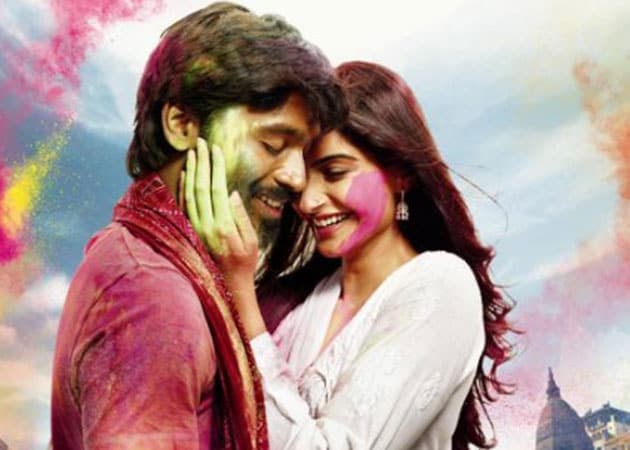
Raanjhanaa film in itself is not a profound film. It has several flaws. Therefore, it cannot be put under the category of ‘Classics’ and yet it did a very good business. Audience gladly responded with laughter to certain situations picturized in the course of this movie. Laughter, in a way, is also a symbol of acceptance. The contemporary audience responds to swearing, double meaning dialogues, atrocious scenes, indecent comments, and vulgar expressions, with a smile and laughs out loud. They enjoy such things in a movie and thus, they have gradually become a part and parcel of contemporary cinema. People actually gave a standing applause in the hall for the performances in this movie. How often do you see that? Such indecency shown in the films imposes a big question mark on the mind - sets of the audience at large. Not only audience these days is accepting it but also calling this movie Raanjhanaa as a tragedy. They were coming out of the cinema hall with happy satisfied faces and remarking that Raanjhanaa was a different movie; unlike most of the films it doesn’t have a happy ending. It came to me as a shock as for me the movie crosses the limits of decency at many points.

An article in Hindu dated July 21, 2013, quotes, “Despite its gimmicky, populist and male favouring one-liners, the film may be interpreted within its generic context. Raanjhanaa is the tragedy of an irrational, impassioned, obsessive lover. Depicting such a crazed state-of-mind on-screen requires the lover doing things that go against ordinary and socially accepted expressions of love. Kundan’s wrist slitting is neither intelligent, nor advisable. It is a device that portrays the crazed intensity of his passion. Similarly driving his scooter into the Ganges with Zoya behind is a reflection of his shock and trauma upon discovering that she loves another man, not an attempt to murder.” The question raised here is that - Is Raanjhanaa the tale of an irrational, impassioned, obsessive lover, or thinly disguised male supremacist storytelling?

Kundan is a deeply flawed character. He’s obsessive, selfish, delusional, mercurial, thoughtless, hugely impulsive, self-destructive and bad tempered! While Zoya is a highly self – centered character who mostly uses Kundan for her own interests. She seldom cares about Kundan’s feelings.  Makers of the film have ensured that both Zoya and Kundan are kept real by making them as vulnerable and flawed as we are. Writer Himanshu Sharma has created a hero harking back to the literary tradition of the intensely-passionate-deeply- flawed-self-destructive-tragic-male-protagonist, seen in almost every ‘great’ tragedy in literature be it Saratchandra’s Devadas or Shakespeare’s Othello. Sharma’s Raanjhanaa remains consistent with the generic patterns of the tragic form, as we are compelled to sympathize with this problematic male protagonist who mistreats the very women he loves but is redeemed by the author in a noble death. Here, in Raajhanaa we similarly tend to sympathize with Kundan and therefore support the idea of a crazy lover.

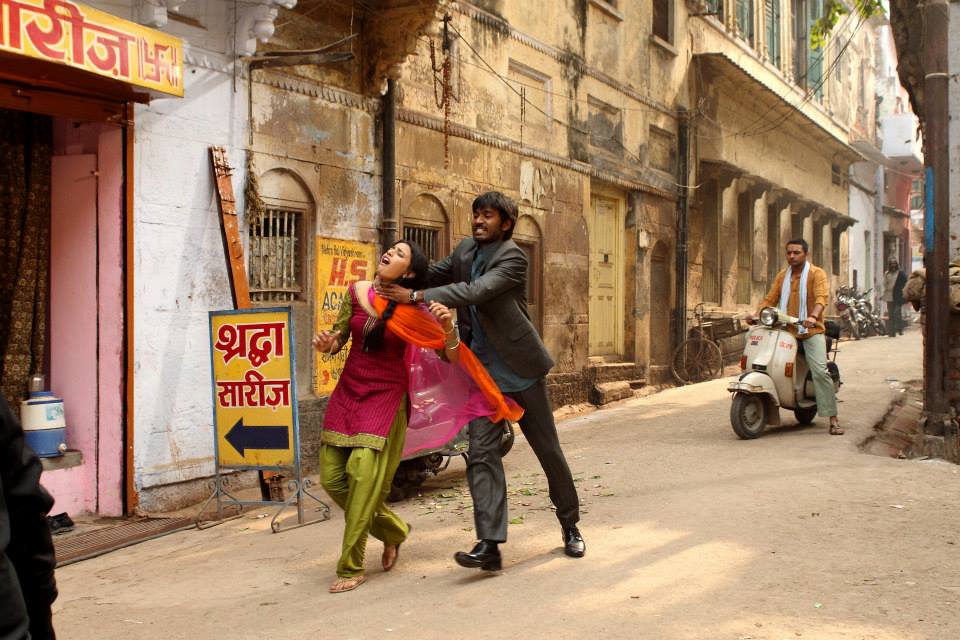
Kundan never becomes a serious figure of threat because Zoya is never shown to be scared of him. Her first response to his overture is a fearless confident taunt and a tight slap. Because Zoya consistently remains unflinching and unafraid, Kundan never fully becomes that sinister, threatening, figure of the dangerous stalker.

Love shown in the movie is more of a violent nature. It is therefore, an unapologetic celebration of crazy love. A story of how love makes otherwise rational people behave in a stupidly self-damaging manner. It is a tale of one – sided love where Bindiya madly loves Kundan and Kundan can only see Zoya. It is an irony that Kundan on one hand remains heartless towards Bindiya and expects Zoya to adhere to his love. 

Looking at the title Raanjhanaa reminds of the legendary love story of Heer Raanjha. However, the character of Raanjha has been highly distorted in this movie. While Raanjha’s love was pure, Kundan’s love is more of an obsession. Kundan is perhaps suffering from Obsessive Compulsive Disorder in medical terms like the main characters of movies Darr, Anjaam, Baazigar, etc.

Raanjhanaa depicts the various shades of manhood and celebrates superiority of masculinity. Our mind - sets are still rooted in the feudal system. It also highlights the so many problems prevailing in our society. The movie indirectly remarks on the disorder in the men mind which leads to cases to rapes, acid throwing, and what not. There is a superiority complex in men these days which is a consequence of the feudal mind – sets. What happened recently in JNU symbolises such narratives are well received in our society. 

The kind of lover shown in the movie cannot be accepted in real life, though audience is romanticising Kundan’s character. Somewhere in our psyche, feudal notion of masculinity continues to exist which compels us to appreciate Kundan’s love for Zoya and we fail to realise that it’s his obsession for her in reality. This is the reason we are responding to such narratives and this particular film has done such a good business.

We believe that over the years we have evolved a lot. Our notion of modernity is limited to clothes and technology merely. Also in reality, our evolution is only materialistic, our mind – set continues to be the same. This movie Raanjhanaa gives us a platform for self – introspection.

The concept of love has widely changed from the purity in Teesri Kasam to the obsession in Raanjhanaa. The image of love and lover being populated through this film is very stereotypical of our society. Nowhere does it give us a new way of looking at man – woman relationship. It does not even explore the nuances of man woman relationship or Hindu – Muslim conflicts. 

Zoya’s character has been criticized largely by popular critics for being manipulative, self – centered, cold and heartless. There can be a different way of looking at her character. Zoya was just a very human, totally realistic and thus imperfect young girl dealing with confusing, and contradictory matters of the heart. There is nothing wrong with an adolescent 14-year old being flattered and responsive to the devotion of a young boy. It’s very natural. In words of Swara Bhaskar, “What is wrong if eight years later she has moved on? In fact Zoya’s character is not calculating but naive in trusting Kundan’s friendship; she’s honest about her lack of love for him, about her boyfriend. She’s perfectly frank and sensible when she asks him if he intends to ruin her life for that one childish mistake she made. And when she lies, it is to save Kundan the pain of realizing that Zoya in fact did not reject him because he was a Hindu, that she simply didn’t love him! With Zoya, Sharma taps another classic literary trope- the unattainable lady love, the mistress-on-a pedestal who the poet will never attain but continually pine for. Zoya is finally redeemed despite all her flaws when she says wretchedly in the climax to Kundan that ‘The world will spit on me if I fall in love with you, but I think I have.’ Zoya’s tragedy is that she must plot murder to prevent herself from falling in love with the very man who ruined her life and accidentally killed her fiancé.”

As much as Zoya hates Kundan’s ‘gawaar’ (villager) notions of romance and pulls him up for slitting his wrists stupidly, she does exactly the same thing in a different context later in the film, without quite realising that she is not very different. She just chose to pretend she was intellectually superior.

Raanjhanaa is clearly not the story of Muslim-Hindu relations in Banaras, nor is it a study of the social relations between the numerous castes that inhabit the city, and it is certainly not the story of some student political movement threatening to sweep Delhi’s assembly elections. Different religions are merely used as a background. Even if Kundan and Zoya belonged to the same caste, the marriage wouldn’t have taken place. Nowhere does this film sensitize the audience about communal disharmony. It doesn’t take you deep into the problem; instead it touches it only at the surface level. Raanjhanaa is the story of a boy who like the Raanjha of folklore fell obsessively in love with an unattainable girl. She loved someone else, and he despite initially trying to help the girl unite with her lover, on learning of her lie to him unthinkingly unleashed a tragedy that ruined the lives of everyone involved and found redemption only in death. 

This film, doesn’t give us any progressive ideas and yet the questions that it raises are important. Love as seen these days, is something meant to be taken. There is no concept of giving involved in the contemporary world. Indian cinema continues to depict love as something to get. Women are like trophies to be achieved and acquired by men. Sentiments of women are never given a purview. 

A quote from Umrao Jaan reads as, 
“Tujhko rusva (disgrace) na kia, 
Hum bhi pasyemaan (embarrass) na huye.
Ishq ki rasam ko, Iss tarah nibhaya humne.”

Although, here in the movie Raanjhanaa, Kundan not only causes embarrassment and disgrace to Zoya, but he makes himself a laughing stock too. Thus, from Umrao Jaan to Raanjhanaa love has changed its dimensions.

Heer Raanjha also differed from Raanjhanaa in its definition of love. Raanjha of folklore believed in love as endurance while this concept of endurance is gradually vanishing these days. There was a time when love was not forced upon, rather it comprised of waiting for the beloved to change her mind. True love is when you are not even sure if your beloved will commit to you, but you still wait for her and keep your expression of love subtle. Sometimes, you have to sacrifice your love as shown in the movie Teesri Kasam. There can be several reasons for this sacrifice, what matters is love, love and nothing else.

Love is not about getting the person always; love is about loving the person.

Men now – a – days, believe mostly in getting his beloved even if it involves following her publically everywhere, discussing about her in front of friends and other people as if she is merely a commodity out there waiting to be possessed by one of them. Such mind – sets have created havoc in our society. Male ego is not strong enough to accept rejection. Image of macho created by the Cinema is ultimately harming our society.

Indian Cinema wasn’t like this earlier. Gradually this concept of obsessive lovers seeped into the Indian Cinema from the movies like Darr, Anjaam, etc. Now, the extend is so much that even our societal mind – set has started reflecting this notion of love resulting in the recent JNU case where an educated guy stooped to such a level that he not only brutally murdered the girl but committed suicide too, all in the name of love. Love is slowly taking the form of heroism. 

It’s very difficult to earmark the characters portrayed in this film Raanjhanaa as black or white. We all are shades of grey after all. Every character in the movie has multiple shades too. 

For instance, take Bindiya; in one scene she prays to Gau-mata for Zoya’s death, due to her undettered love for Kundan despite constant humiliation and beatings, and next moment she also participates in the plan to rid Zoya from an unwanted suitor.

Not only love and endurance but the concept of Deewangi has also taken a major turn. The Deewangi in Kundan and Zoya is nothing as compared to the Deewangi of Raanjha, Majnu, and even Meera. Rather the concept of Deewangi has been trivialised in this movie. It has been presented to the audience as a commodity, something that is saleable. We need to stop and introspect ourselves that in which direction are we headed to? 

This film by and large is a signifier of the sickness pertaining in our society. This ailment has ruined our existence in the society. Women are seen as things to possess. We are largely witnessing cases of male superiority existing in our patriarchal society in the form of rapes, recent JNU case, as well as Honour Killing which includes the recent Kolkata Case where a brother actually beheaded his sister’s head and took it to the police station to show that he killed his sister as she loved someone. Such cases leave me bitter. It indicates the abnormality and perversion of human minds. Raanjhanaa reflects to these problems prevailing in our society by the various street plays shown in between the plot. 

Position of women in society is also being questioned. How Zoya’s father slaps her and sends her immediately to Aligarh initially and later tries to get her married without her say. Whenever there is a love triangle in Indian Cinema, one man sacrifices his love for the other. But nowhere the say of the girl is taken in view.

Kundan in my eyes is not a romantic poetic lover. He is more of a stalker, a Roadside Romeo. Problem with Indian Cinema these days is that it has created a melodrama of love. We have started believing that what we see on screen is true love. Media is powerful and it has somehow managed to create a different meaning and identity of love and lover for us. These concepts of love need to be questioned.

Lovers these days have become self – centered. The happiness of their beloved is no longer counted. They have failed to understand the real meaning of love lies in the happiness of the beloved.

Kundan seems to be a lover only till the point where he first proposes Zoya. That moment onwards, the love portrayed gets cheap as he publically holds Zoya’s hand causing disgrace and embarrassment. He lies about his name and has no shame even when Zoya tells him that she will slap him. In fact, he turns so shameless in her love that he gladly gets slapped 15-16 times by Zoya on the street.

The opening dialogue of the movie, ‘Ladki aur rocket insaan ko kahi bhi le jaa sakte hai’ is again stereotypical in nature. Kundan’s dialogue, ‘Humein pakadna muskil hi nhi namumkin tha’ taken from the movie Don, indicates his own perception of himself which wasn’t good. He considered himself as a carefree guy, a brat. Also, this dialogues and various old songs taken from different movies over the journey of Indian Cinema like ‘Bas ek sanam chaiye, Humka ishq hua hai yaaro, Saamne ye kaun aaya, etc.’ hint at the Inter – texuality in the movie. Zoya’s utilitarian attitude is clearly reflected in her dialogue, ‘Do ghante ke liye baat ki hai, 200 ka kaam karne de usey’. Jasjeet’s dialogue, ‘Inn ladkiyo ke dimaag ke hisaab se kuch nhi karna chaiye’ again hints towards male chauvinist attitude and stereotype of men. 

References to Ramayana at several points like, ‘Ramayana mei sirf Sundar kaand nhi hota, Lanka Dehen bhi hota hai.’ ‘Bal kaand samaapt aur Lanka Dehen shuru.’ are merely because Kundan is a son of a practising Brahmin. Also, it says that the playfulness of his life is over, and now the war has begun. It is merely included to refer to the new phase added to his life. 

Inspite of all the criticism, there is no denying that Raanjhanaa is a brave film to explore the crevices of young minds that straddle many worlds — social, intellectual, political and personal — that it is easy to lose your mind in the complex politics of modern relationships. Raanjhanaa has a male – centric perspective clearly and is disturbing as well as emotionally challenging.

WORD COUNT : 2615

Sunday, August 11, 2013

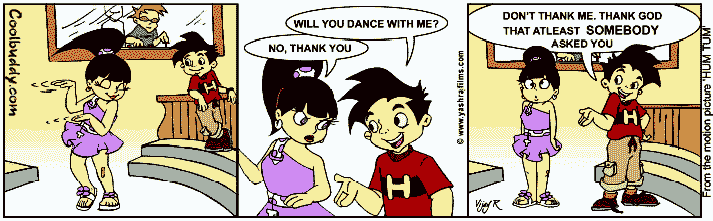
Hum Tum : Extended!


I and He Series continues...


He - I just want you to trust me.
I - I do trust you.
He - Stop worrying then. We will be together.

****

I - You love me?
He - No, I live you.


****

I - Wait for 2 min. I'll be back.
He - Ok baby.
(After an hour)
I - Hi.
He - Uff..Tum ladkiyon ke 2 min.
I - ;)

****

He - I love you even if you don't know how to cook. In fact I will love you even more.
I - Aww...how sweet! :* :*
He - yaar agar itne kisses milne waale hai toh khaana bhi main hi bana dunga.
I - :D 

****

I - I hope you can hear me coz I miss you, everyday, every night, every moment, all the time! I feel you around me. I feel you are watching me. I talk to you in my head and wish you to be there for real...Wow I can write a song after all.
He - Yes you can. You have made my life poetic.

****

He - Do you need anybody else to talk to when you have me?
I - kisi aur mei wo baat kaha jo tum mei hai. Kisi mehfil mei wo nasha kaha jo tumhari baaton mei hai.
He - Arey waah. Dil chu lia.
I - :P


TUM: Aaj Tumhare Liye kuch khana bana ke lati hoon .Kya Khaoge ?
HUM: wah Parante le aana
TUM: hamesh parathe hi to laati hoon!
HUM: Sandwitch le aana
TUM: usme pakana thode hi hota hai
HUM: Dosa Le aana phir
TUM: usme bahut time lagta hai
HUM: Chhole bana lo
TUM: pehle batan tha ,chhole bhiga ke rakh deti
HUM: Pooriyan ?
TUM: pet kharab ho jayega itna tel kha ke.
HUM: fried rice ?
TUM: last week hi to layi thi
HUM: to jo marzi le aana
TUM: batao na kya laoon
:O :O

She Fell (Fail) In Love...Once Again - Book Review


She Fell (Fail) In Love…Once Again
By Ramesh Tehlani
Review By Ila Garg

The 388 page novel, She Fell (Fail) In Love…Once Again, has been published by Notionpress which is a self-publishing firm. The debut author Ramesh Tehlani, wishes to entertain his readers by sharing his experience of corporate world with real life love stories by mixing imagination and personal development theories.

The cover of this novel is appealing as it depicts a girl looking dejected with certain hope in her eyes. The title is slightly mysterious too.

As I began reading this particularly long novel, I felt as if I’m reading a slightly distorted version of Paulo Coelho’s Eleven Minutes. I was therefore disappointed at first. The initial story was therefore more of a repeat telecast for me. It had nothing new to offer. But soon it began taking turns and got interesting.

She Fell (Fail) In Love…Once Again, is a real life tale of Shreeti Sharma, young girl, working with private bank in small town Ajmer. In search of Mr. Right, she met some people in journey of life and fell in love with them. In expectations of long life bond, she received betrayal with life changing lessons and experiences about Pain, Pleasure, Sex, Spirituality, Social Rules, Ethics, Personal Development, Office Politics etc. After many experiences of failure and betrayal, now she fell in love…once again. This time, will she get long lasting love or will she fail in love, again? In her journey of search she learnt life-changing concepts like: Why Extra Marital Affairs are not wrong... Why Physical Relations without marriage are not wrong... Why women gives sex for love and men gives love for sex... How pain gives pleasure… How to face office politics and recession… How one can increase his/her value in job and society by using ‘Quiwam Theory’ and ‘Why Apple is costlier than Potato Theory’… And other new aspects of life…

This novel in a way explores various bold realities in the evil world we are living in. Themes that are taboo are discussed in the course of this novel. The author has skilfully tackled the complexity of the protagonist’s character.

The author has written a brilliant climax of the story that keeps the readers glued till the very end. The too many failures of Shreeti’s love life is just one of the reasons you want to keep turning the pages to find out what happens in She Fell (Fail) In Love…Once Again. It took me a little more time than usual to read this complete novel as it gets too heavy as you enter into Shreeti’s world full of struggles. Her story makes you cry and wonder how men can be this cruel.

To find out whether Shreeti finally gets her Mr. Right or not, what happens to her family, how she keeps earning her livelihood, does she finally gets settled, her belief in love strengthens towards the end or she remains shattered, her father’s predictions were true or was she able to carve her own destiny, does she gets a happy ending or not; you will have to read the novel, She Fell (Fail) In Love…Once Again.


badge